Self-Government – Home Rule – The Kingdom of Denmark
In 1721, the Danish-Norwegian priest Hans Egede arrived in Greenland. His mission was to convert the Inuit (the Indigenous population) to Christianity. Later, the Danes also sought to profit from fisheries and whaling.
In 1933, the International Court of Justice in The Hague granted Denmark authority over Northeast Greenland in a case brought by Norway, which claimed sovereignty over East Greenland. The conflict arose because Norwegian hunters increasingly used the area during the summers in the late 19th century.
Until 1853, anyone wishing to enter the inhabited parts of Greenland had to apply for permission from the Danish state, which was difficult to obtain unless the applicant had an approved purpose. Hunting was usually not considered sufficient.
A 1924 agreement between Denmark and Norway gave Norwegians the right to hunt in uninhabited areas, build cabins, and operate weather and radio stations. The countries agreed, however, that the question of sovereignty over East Greenland remained unresolved.
In 1933, the court ruled in Denmark’s favor and concluded that the Norwegian occupations were illegal and invalid. Norway recognized Denmark’s sovereignty over all of Greenland, but was allowed to continue activities under the 1924 agreement until 1959.
World War II and Changing Governance
During World War II, contact between Denmark and Greenland was cut off. The governors Eske Brun (1904–1987) and Aksel Svane (1898–1991) assumed administrative control to maintain Greenland as Danish territory. They also entered into an agreement with the United States regarding the protection and supply of Greenland.
After the war, Denmark signed the UN Charter, committing itself to improving conditions in its colonies. The following year, Denmark formally registered Greenland as a colony with the UN.
Modernization and the G50 Reforms
The Greenland Commission proposed a series of social, political, and economic reforms for Greenland. These proposals, known as the G50 Plan, were adopted and marked the beginning of large-scale modernization. The goal was to bring Greenlandic society closer to Danish standards. Fishing was to replace hunting as the main occupation, and the population was encouraged to move to towns near newly built fishing facilities.
The Birthplace Criterion
The birthplace criterion, introduced in 1964, governed the salaries of state employees in Greenland. People born in Greenland—or living permanently there before age five—received lower wages and poorer conditions regarding housing, travel, and benefits than Danes sent from Denmark. The motivation was to avoid large wage gaps and to protect the competitiveness of private Greenlandic businesses.
However, the system became politically controversial. After Home Rule was established in 1979, the Greenlandic government administered the system until it was abolished for wages in 1989 and for other employment conditions in 1991.
The Closure of Qullissat
The coal-mining town Qullissat, one of Greenland’s largest towns at the time, was closed when the state-run mine was deemed unprofitable. The decision was made jointly by the Danish Parliament and the Greenland Landsråd (the pre-Home Rule council). At the time of evacuation, the town had more than 1,000 residents. Supplies were discontinued, and residents were offered housing elsewhere.
Qullissat was known for its active labor movement, which advocated for miners’ rights, and for its vibrant cultural life. The music genre Vaigat music originated there.
EC Membership and the Path Toward Home Rule
Greenland became a member of the European Community (EC) together with Denmark, even though a majority in Greenland opposed membership.
The Danish-Greenlandic Home Rule Commission was established after Home Rule had first been discussed in a purely Greenlandic committee (1971–1975). In Narsaq in 1976, a new tradition called Aasivik emerged—summer gatherings where young Greenlanders discussed politics and Greenlandic identity.
The 1977 Aasivik meeting resulted in a joint statement demanding recognition of the Greenlandic people. One of the founders was Aqqaluk Lynge, who later became the first chairman of the political party Inuit Ataqatigiit (IA).
The First Political Parties
The first Greenlandic parties were formed around this time:
- Siumut
- Inuit Ataqatigiit (IA)
- Atassut
All three parties still exist.
Siumut was founded by Moses Olsen, Jonathan Motzfeldt, and Lars-Emil Johansen, who led efforts to achieve Home Rule. IA was established the same year as a breakaway faction from Siumut. Atassut, founded in 1978, supported maintaining strong ties with Denmark.
Greenland Votes for Home Rule (1979)
On 1 May 1979, Greenland introduced Home Rule after a referendum in which 75% voted in favor. Several areas of responsibility were taken over, including health care, culture, the church, and education.
The parliament was named the Landsting, and the government became the Landsstyre. These names were replaced with Greenlandic names in 2009 with the introduction of Self-Government.
Greenland’s Flag (1985)
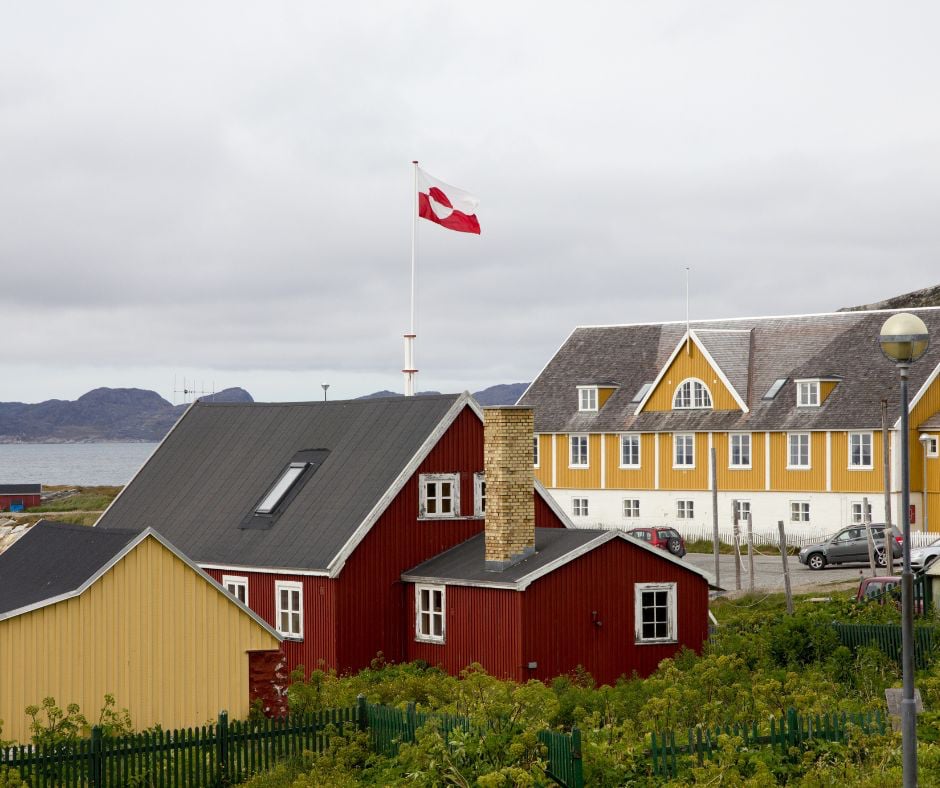
In 1985, six years after the introduction of Home Rule, Greenland adopted its own flag, designed by artist Thue Christiansen. The red and white colors symbolize Greenland’s ties to Denmark, and the design shows the sun setting over the sea.
Although today many more people use the Greenlandic flag, some—particularly older generations—continue to use the Danish flag.
The same year, Greenland withdrew from the European Community and became part of the OCT system (Overseas Countries and Territories).
Greenland and the OCT System
Instead of being an EU member, Greenland is part of the Overseas Countries and Territories (OCT) framework. The group consists of former European colonies; Denmark has one OCT territory (Greenland), while France and the Netherlands together have twelve.
Greenland maintains a Representation Office in Brussels, consisting of a Head of Representation, a secretary, an administrative staff member, and an intern. The office shares facilities with the Danish Embassy and is located close to the European Parliament, where meetings and hearings take place daily.
Monthly coordination meetings are held with the other OCT members.
Abolition of the Birthplace Criterion
The birthplace criterion—implemented since 1964 to ensure higher wages for Danes than for Greenlanders—was finally abolished.
The separation of Danish and Greenlandic schoolchildren was also ended. Previously, Danish children attended separate classes from Greenlandic children, effectively creating an A-team and a B-team.
Towards Self-Government (2009)
Twenty years after the introduction of Home Rule, a Self-Government Commission was established to draft a framework for future Greenlandic self-government. Its task was to propose how Greenlandic authorities could assume additional powers in accordance with Greenland’s constitutional position and the Greenlandic people’s right to self-determination under international law.
Self-Government became a reality on 21 June 2009, Greenland’s National Day.
The Landsting and Landsstyre were renamed:
- Inatsisartut (Parliament)
- Naalakkersuisut (Government)
Inatsisartut consists of 31 members. Naalakkersuisut is Greenland’s executive government.
Political Developments and Leaders
Muté B. Egede
Since 2021, Muté B. Egede, the leader of IA, has been the Premier of Greenland (Chair of Naalakkersuisut). Born in 1987, he is the youngest leader in Greenland’s history and the second IA politician to hold the premiership. IA maintains a strict zero-tolerance policy on uranium mining, originally introduced in 2009.
The policy was abolished when Aleqa Hammond became Premier in 2013, enabling companies such as Greenland Minerals to continue uranium exploration at Kuannersuit/Kvanefjeld near Narsaq.
Muté B. Egede reinstated the zero-tolerance policy, effectively stopping further exploration at the site.
Aleqa Hammond and the 2014 Scandal
In April 2013, Aleqa Hammond became the first female Premier of Greenland and regained power for Siumut after 30 years. Her campaign focused on tightening requirements for foreign companies and increasing royalties on mineral extraction.
In September 2014, it emerged that she had misused more than 100,000 DKK in public funds. The scandal triggered large demonstrations. For the first time in Greenlandic history, members of Inatsisartut were escorted by police.
Aleqa Hammond was expelled from Siumut. Kim Kielsen became party leader and served as Premier until 2021.
The 2025 Election
A general election was held on 11 March 2025.
The results were:
- Demokraatit won unexpectedly with 30% of the vote.
- Jens Frederik Nielsen became Premier.
- Naleraq came second with almost 25%, doubling their previous result.
- Inuit Ataqatigiit (IA) received 21%, a significant drop from 36% in 2021.
- Siumut received 14%, half of what they achieved in 2021.
- Atassut received 7.3%, roughly the same as in the previous election.
Timeline of Greenland’s History
1721–1900: Early Colonial Period
1721 – Hans Egede arrives in Greenland to convert the Inuit to Christianity.
Late 1800s – Norwegian hunters increasingly use Northeast Greenland during summer, leading to territorial disputes.
1853–1933: Sovereignty Questions
Until 1853 – Entry into inhabited Greenland requires permission from the Danish state.
1924 – Denmark and Norway sign an agreement allowing Norwegians to hunt and build stations in uninhabited areas, without resolving sovereignty.
1933 – The International Court of Justice rules in Denmark’s favor; Norway recognizes Denmark’s sovereignty over all of Greenland.
1939–1959: World War II and Aftermath
1940–1945 – Contact with Denmark breaks during the German occupation; Eske Brun and Aksel Svane administer Greenland and sign a protection agreement with the United States.
1959 – Norway ends activities under the 1924 agreement.
1945–1964: Modernization Begins
1945 – Denmark signs the UN Charter and registers Greenland as a colony.
1950s – The Greenland Commission prepares modernization proposals.
1950–1953 – The G50 Plan is adopted, shifting Greenland toward modern fishing and urbanization.
1964–1978: Social Reforms and Rising Politics
1964 – The birthplace criterion is introduced, giving Danes higher wages than Greenland-born employees.
1971–1975 – A Greenlandic committee discusses Home Rule for the first time.
1976 – Aasivik summer gatherings begin in Narsaq, focusing on Greenlandic identity and political debate.
1977 – Aasivik issues a declaration demanding recognition of the Greenlandic people.
1977–1978 – Political parties emerge:
- Siumut
- Inuit Ataqatigiit (IA)
- Atassut (1978)
1979–1989: Home Rule Era
1 May 1979 – Greenland votes 75% in favor of Home Rule; Landsting (Parliament) and Landsstyre (Government) are established.
1985 – Greenland adopts its own flag and withdraws from the European Community, joining the OCT system.
1989 – Birthplace criterion abolished for wages.
1991–2009: Toward Self-Government
1991 – Birthplace criterion abolished for all employment conditions.
Late 1990s–2000s – Preparation for expanded autonomy continues.
2009 – Self-Government is introduced on 21 June; Landsting becomes Inatsisartut, and Landsstyre becomes Naalakkersuisut.
2013–2014: Political Shifts and Scandals
2013 – Aleqa Hammond becomes Greenland’s first female Premier; focuses on resource control and royalties.
2013 – Zero-tolerance for uranium is removed, enabling uranium exploration at Kuannersuit/Kvanefjeld.
September 2014 – Hammond is caught misusing public funds; protests erupt; parliament members are escorted by police.
2014 – Hammond is expelled; Kim Kielsen becomes Premier.
2021–2025: New Leadership and Policy Reversals
2021 – Muté B. Egede (IA) becomes the youngest Premier in Greenland’s history; reinstates zero-tolerance for uranium, halting the Kuannersuit mine project.
2025 (11 March) – General election results:
- Demokraatit wins (30%) – Jens Frederik Nielsen becomes Premier
- Naleraq: ~25%
- IA: 21%
- Siumut: 14%
- Atassut: 7.3%
Additional Developments
1985–present – Greenland participates in the Overseas Countries and Territories (OCT) system; establishes representation in Brussels.
Monthly – Meetings are held with the 12 other OCT territories.
School reform (date unspecified) – Separation of Danish and Greenlandic students is abolished.